Structural Drying & Dehumidification in Texas After Water Damage
Extraction removes the water you can see. Structural drying removes the water soaked into walls, framing, slabs, and floors — and in Texas humidity, that second job decides whether a home truly recovers or quietly grows mold behind the paint.
Direct answer: Structural drying is the controlled process of removing trapped moisture from a home's building materials — drywall, framing, subfloor, slab, and insulation — after standing water has been extracted, using industrial air movers to evaporate moisture and commercial dehumidifiers to pull it out of the air. Extraction alone is never enough, because soaked materials hold water long after floors look dry, and in Texas, where Gulf humidity and warm temperatures keep indoor air moist, undried framing and wall cavities can stay wet for weeks and develop mold. A home is only dry when moisture meters confirm every material has reached its dry standard, not when surfaces feel dry to the touch.
What Is Structural Drying — and Why Extraction Alone Is Not Enough?
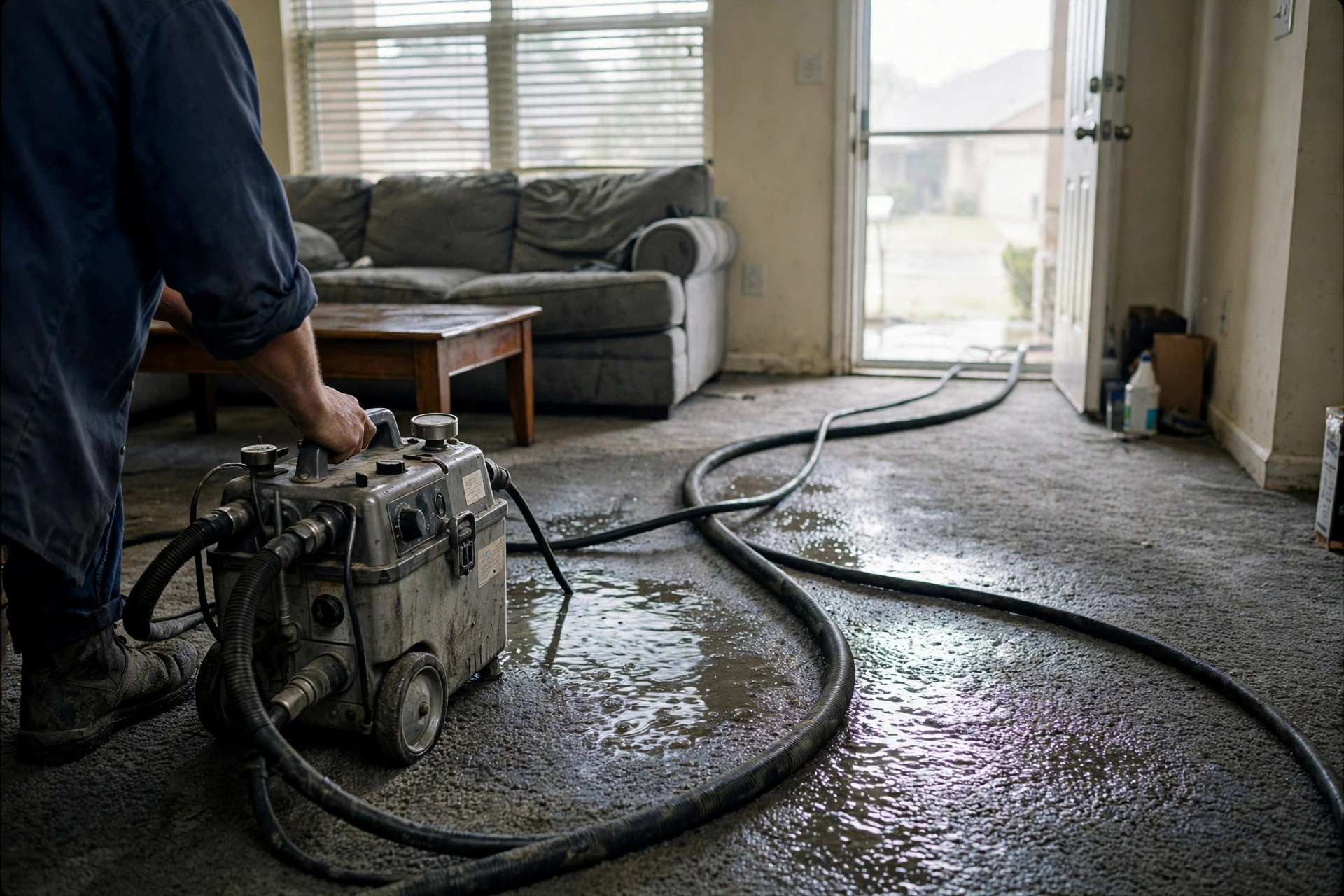
Extraction clears standing water. Drying is the longer job that follows: pulling the water that soaked into everything the flood touched.
When a pipe bursts, a storm floods a home, or an appliance line fails, the first emergency is obvious: standing water on the floor. Pumps and truck-mounted extractors remove that water fast, and once the floors are clear, it is tempting to believe the emergency is over. It is not. By the time standing water is gone, a large share of the total water in the home is no longer on the floor at all. It has wicked upward into drywall, soaked into baseboards and framing, seeped beneath flooring into the subfloor, and settled into insulation inside wall cavities. None of that water is visible, and none of it leaves on its own in any reasonable timeframe.
That hidden water is what structural drying exists to remove. The goal is not to make a room look dry or feel dry. The goal is to return every affected building material to the moisture level it held before the loss — its dry standard — so that it does not warp, weaken, smell, or support mold growth later. Drywall that stays wet loses strength and crumbles. Wood framing that stays wet can swell, warp, and eventually decay. Insulation that stays wet stops insulating and becomes a damp blanket pressed against framing. A slab that stays wet keeps feeding moisture upward into flooring for months. Each of these problems starts invisibly, which is why drying is a measured, monitored process rather than a matter of running a few fans and waiting.
Texas makes the distinction between extraction and drying sharper than in most states. Much of Texas is warm and humid for most of the year, and along the Gulf Coast the outdoor air itself is often saturated. Air that humid cannot absorb much additional moisture, so wet materials dry slowly unless dehumidifiers actively strip moisture from the indoor air. At the same time, Texas construction creates hiding places for water: slab-on-grade homes carry no crawlspace beneath the floor for air to circulate, attic spaces run hot and trap humid air, and expansive clay soils shift foundations and open small pathways for water to travel under flooring. A home that looks dry after extraction in a Texas summer can still be wet inside its walls a week later — and the homeowner may only discover it when paint bubbles, a musty smell appears, or a baseboard pulls away from the wall.
The practical consequence is simple: extraction and drying are two halves of one job, and skipping the second half undoes the first. A fast extraction followed by no drying leaves the structure wet. A thorough drying program, by contrast, protects everything the extraction saved — the framing, the subfloor, the flooring that was not removed, and the wall cavities that were never visibly flooded. Homeowners should expect drying equipment to remain in place for days, expect technicians to return to take readings, and be suspicious of any approach that declares a home dry on the basis of appearance alone.
The process
How Structural Drying Works, Step by Step
Drying is not guesswork. It follows a sequence: measure, set up, evaporate, capture, verify. Each step exists because skipping it leaves water behind.
Moisture Mapping Before Equipment Arrives
Technicians map the full wet footprint with penetrating and non-penetrating moisture meters and infrared cameras before placing a single air mover. This map shows which walls, cavities, and floor sections are wet, how deep the moisture goes, and which materials can be dried in place versus which must be removed. In Texas slab homes, the map also checks for moisture trapped beneath flooring, where water travels along the slab far from the original leak.
Removing What Cannot Be Dried
Saturated carpet padding, swollen particle board, waterlogged insulation, and collapsed drywall generally come out before drying begins. These materials either cannot be dried reliably or dry so slowly that they hold moisture against framing while everything else dries. Removing them opens wall cavities and floor assemblies so air can actually reach the wet surfaces behind them.
Setting Up Airflow and Dehumidification Together
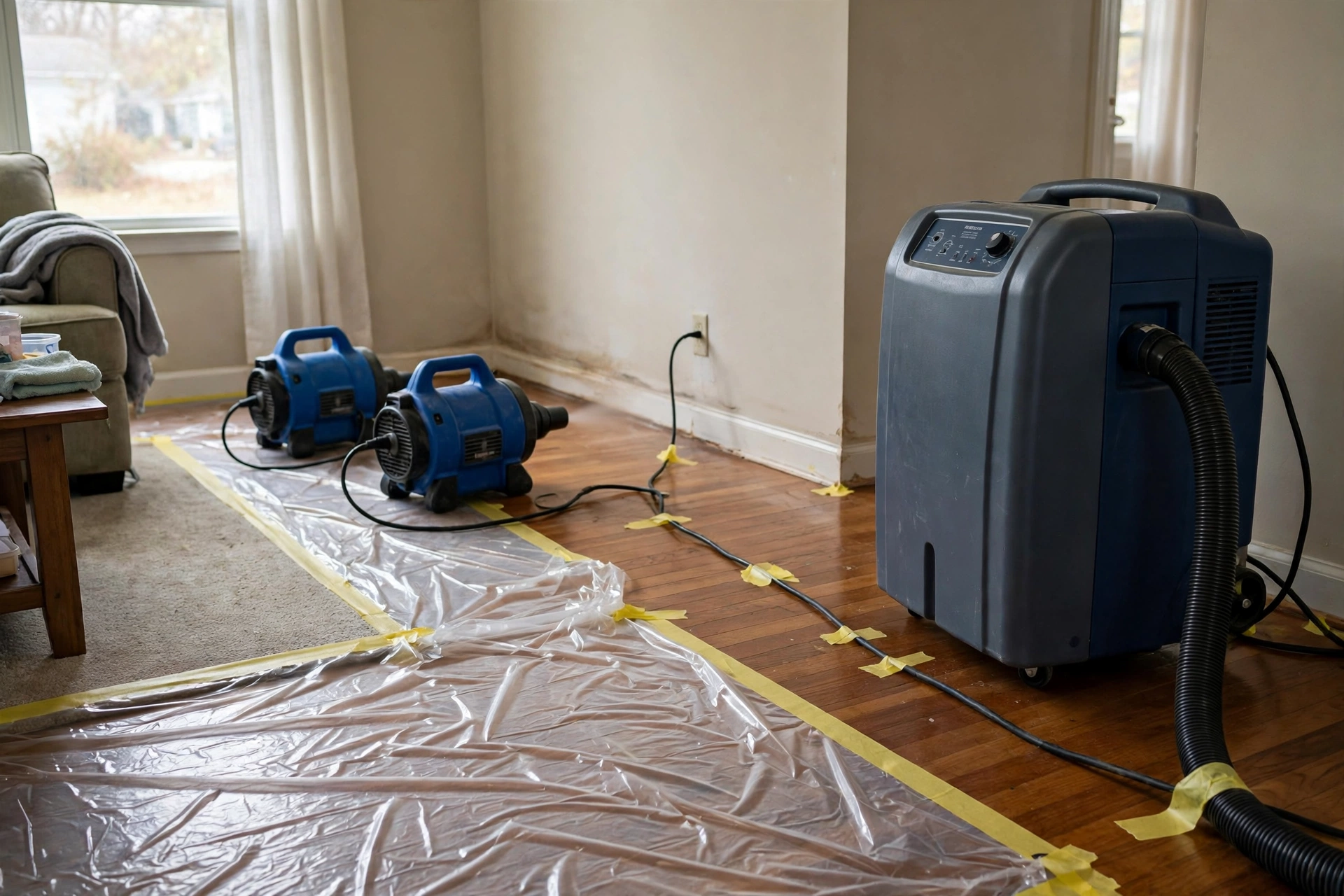
Air movers are positioned to push high-velocity air across wet surfaces and into wall bases and cavities, while commercial dehumidifiers are sized to the volume of the affected space and the amount of water present. The two work as a pair: air movers turn trapped liquid moisture into airborne vapor, and dehumidifiers remove that vapor from the air. One without the other fails — airflow without dehumidification just moves humidity around, and dehumidification without airflow leaves moisture locked inside materials.
Creating a Controlled Drying Chamber
Technicians often seal off the affected area with plastic containment so the equipment dries a defined volume of air rather than fighting the humidity of the whole house. Doors and windows in the drying zone stay closed, and the home's air conditioning is usually set to support dehumidification rather than working against it. In a Texas summer, an open window can flood a drying chamber with humid Gulf air and undo a day of progress.
Daily Monitoring and Equipment Adjustment
Technicians return to take moisture readings, check temperature and relative humidity, and adjust equipment placement as the drying front moves. Wet materials dry unevenly — a wall base may dry while the upper cavity stays wet, or a slab section may lag behind the framing above it. Monitoring catches those lags and moves air movers to where the moisture remains, rather than leaving equipment in place on a fixed schedule and hoping.
Verification Against Dry Standards
Drying ends when readings confirm it, not when a calendar says so. Technicians compare each material's moisture content against the dry standard measured from an unaffected area of the same home — a dry wall in another room, an untouched section of framing. Only when every affected material meets that standard is the equipment removed and the drying job considered complete.
Antimicrobial Treatment and Handover
Once materials are verified dry, affected surfaces are typically treated with antimicrobial products to discourage mold and bacteria, and the home is documented with final readings. That documentation matters for insurance claims and for any future buyer or contractor who needs to know the structure was dried to a verified standard rather than simply aired out.
Equipment
Air Movers vs. Dehumidifiers: Two Jobs, Not Two Options
Homeowners often ask whether fans or a dehumidifier will do the job. The honest answer is that neither works alone — and in Texas, the dehumidifier side of the pair carries an unusually heavy load.
An air mover is not a household fan scaled up. It is a focused, high-velocity machine designed to push a sheet of air across a wet surface and into the base of a wall cavity, accelerating evaporation from the material into the air. Placed correctly, air movers create a continuous flow that strips the thin layer of saturated air sitting against a wet surface and replaces it with drier air, so evaporation continues. Placed poorly — pointed at the middle of a room, or at a wall that is already dry — they accomplish little. Technicians angle them along walls, into cavities through small openings, and beneath raised flooring systems, and they reposition them as readings change.
A dehumidifier does the second half of the job: it takes the vapor the air movers created and removes it from the air as liquid water, which drains away or collects in a reservoir. Without it, evaporated moisture simply hangs in the room's air until it is reabsorbed by the driest material available — often the very framing that just dried, or an unaffected wall nearby. This is why a home dried with fans alone can feel dry in the afternoon and smell musty by morning: the moisture never left the building, it only relocated.
Equipment
What It Does
Its Texas Challenge
Industrial air movers
Drive high-velocity airflow across wet surfaces and into wall cavities to evaporate trapped moisture
Hot attics and closed slab homes limit natural airflow, so placement and containment matter more
Low-grain refrigerant dehumidifiers
Pull large volumes of moisture from the air, including in warm conditions, keeping indoor humidity low enough for evaporation to continue
Gulf humidity means incoming air is already wet — the drying chamber must stay sealed
Desiccant dehumidifiers
Use a drying rotor to strip moisture even in cool or very humid conditions, useful in cold homes after a freeze event
Freeze-damaged homes without heat dry slowly until temperature is restored
Moisture meters and infrared cameras
Measure moisture inside materials and reveal wet areas hidden behind paint and flooring
Slab moisture and attic insulation hide water from sight — meters find what eyes miss
Injectidry and cavity-drying systems
Force warm, dry air directly into wall cavities, under cabinets, and beneath flooring without tearing everything out
Texas wall cavities packed with insulation resist airflow and need targeted injection
Why Texas Humidity Changes the Equation
Evaporation only happens when the air touching a wet surface can accept more moisture. In the Texas Panhandle on a dry winter day, that is relatively easy. Along the Gulf Coast in August, or in a Central Texas home in a humid spring, the air may already hold so much moisture that evaporation stalls — wet drywall in a humid room dries barely faster than it would sealed in a bag. Commercial dehumidifiers solve this by driving indoor relative humidity down to a range where evaporation resumes, but they can only do that inside a sealed drying chamber. Every open exterior door, every window cracked for fresh air, and every unsealed attic access in the drying zone lets humid outdoor air back in and resets the clock.
Heat complicates the picture in the opposite direction. A Texas attic in July can exceed temperatures that make working conditions difficult and can warp already-wet materials faster, while a home left without air conditioning after storm damage turns into a warm, humid box — ideal conditions for mold. Drying crews therefore manage temperature as well as humidity: restoring cooling where possible, venting attic heat where it traps moisture, and never assuming that Texas warmth alone will dry a structure. Warmth without dehumidification is not drying. It is incubation.
Materials
Drying Different Materials: Drywall, Framing, Slab, Wood Floors, and Insulation
No two materials dry the same way. A method that saves hardwood can ruin drywall, and a slab that looks dry can keep feeding moisture into flooring for months.
Texas slab-on-grade homes are the state's defining drying challenge: water trapped between slab and flooring has nowhere to drain and no air beneath it.
Slab moisture must be measured through the flooring, not guessed from the surface — a floor that feels dry can still be wet underneath.
Drywall and Plaster
Drywall wicks water upward like a sponge, often well above the visible water line, and its paper facing is a food source for mold once wet. Lower sections that soaked for hours are usually cut out to the flood line so the cavity behind them can dry; upper sections that are only damp can often be dried in place with directed airflow. The key measurement is inside the cavity, not on the painted face — a wall can look intact while its inner face and insulation remain saturated.
Framing and Studs
Wood framing dries more slowly than drywall and is more forgiving: solid lumber can usually be dried in place if airflow reaches it and dehumidification keeps pace. The risk is time. Framing that stays wet for weeks can warp, and framing trapped behind wet insulation dries slowest of all, because the insulation blocks airflow and holds moisture against the wood. Opening cavities and removing wet insulation is often what makes framing drying possible at all.
Concrete Slab
Concrete absorbs water and releases it slowly, which makes slab drying the longest phase in many Texas homes. Moisture meters and relative-humidity probes in the slab itself — not surface readings — tell technicians whether the slab is still emitting moisture. Flooring laid over a damp slab will buckle, cup, or grow mold underneath, so flooring is generally not reinstalled until slab readings meet the standard. In homes built on expansive clay soils, slab movement can also crack flooring and open new moisture pathways, which is why technicians check the whole slab footprint, not just the room that flooded.
Wood Floors
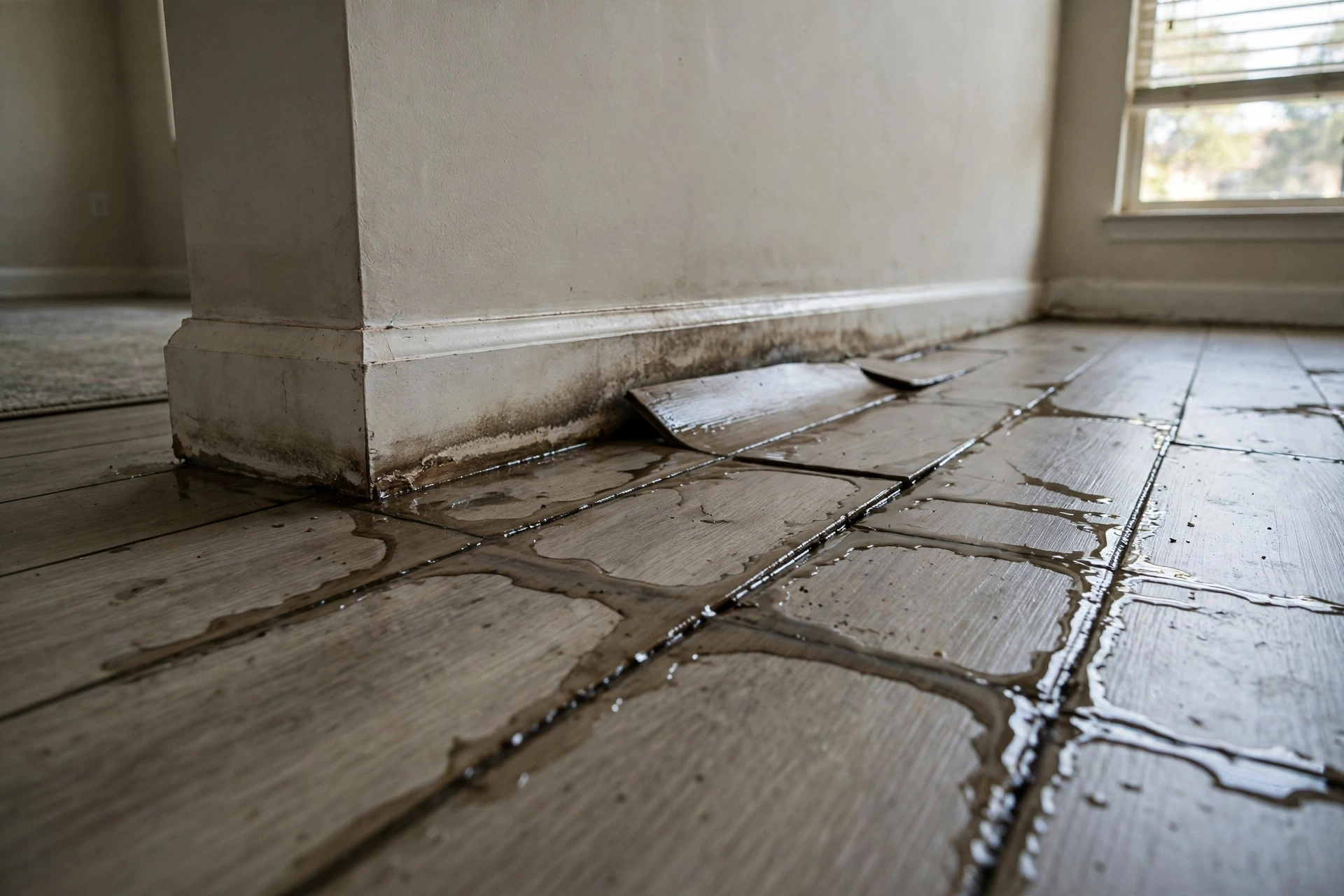
Hardwood floors cup when their undersides absorb more moisture than their finished tops, and they can sometimes be saved if drying starts quickly and specialized floor-drying mats pull moisture evenly from boards. The window is narrow: boards that have cupped severely, buckled, or stayed wet for many days often cannot be returned to flat, and refinishing a floor that is still wet underneath traps moisture and guarantees future problems. Engineered wood and laminate behave differently — laminate with a fiberboard core often swells irreversibly — so technicians identify the flooring type before choosing a drying method.
Insulation
Fiberglass insulation loses much of its insulating value when wet and dries very slowly inside a closed cavity, which is why saturated insulation is usually removed rather than dried. Cellulose insulation absorbs even more water and can compact into a damp mat. In Texas attics, wet insulation is a double problem: it holds moisture against ceiling drywall and framing above living spaces, and attic heat accelerates mold growth in it. Removing wet attic insulation, drying the framing and ceiling assembly, and then re-insulating is the standard sequence.
Subfloor and Cabinets
Plywood and oriented strand board subfloors swell at edges and seams when wet, and the swelling can telegraph through finished flooring above. Particle-board cabinet bases and vanities are among the least salvageable materials in a flood — they swell, crumble, and rarely dry to a usable state. Technicians measure subfloor moisture through the finished floor where possible and remove unsalvageable cabinetry so air can reach the wall and floor behind it.
Verification
How Technicians Know When Something Is Truly Dry
Touch lies. Meters do not. Here is what professional verification actually involves — and why it is the step that protects everything after it.
A wall is dry when its moisture reading matches an unaffected wall in the same home — not when it feels dry, looks dry, or has had fans on it for a set number of days.
That comparison, called the dry standard, is the whole basis of verification.
Every material has a normal moisture range, and that range varies by material, season, and region. Wood framing in a humid Gulf Coast home naturally reads higher than framing in a dry Panhandle home in winter. Technicians therefore establish the dry standard from the home itself: they take readings from unaffected areas built of the same material — a dry wall in an untouched room, an unexposed section of framing — and use those readings as the target. Affected materials are considered dry when they return to that range, not when they hit an arbitrary number from a chart.
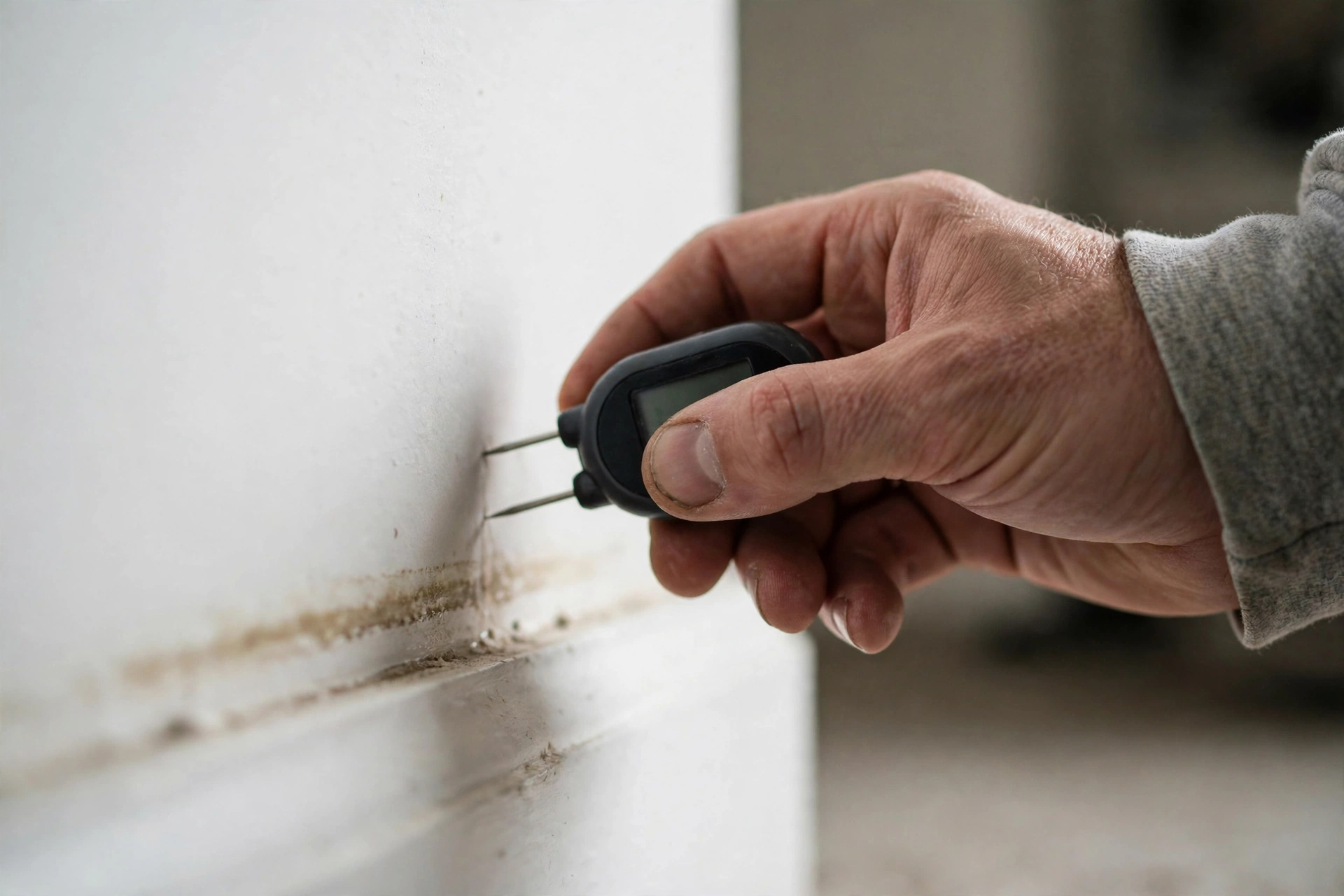
Three tools do most of the verification work. Pin meters drive small probes into wood and drywall and read moisture content directly inside the material. Pinless, or search-mode, meters scan larger areas without holes and are useful for finding wet patches across a wall or floor. Infrared cameras do not measure moisture at all — they measure surface temperature, and wet areas cool differently than dry ones — but they are excellent for finding hidden wet spots to confirm with a meter, especially inside ceilings below an attic leak or behind tile. Used together, the three tools produce a moisture map that can be compared day by day until the map is clean.
Homeowners should ask to see those readings. A reputable crew records moisture levels at the start, during monitoring visits, and at completion, and can show the trend: readings falling toward the dry standard across every affected material. If readings plateau above the standard, drying continues or the approach changes — more airflow into a cavity, removal of a stubborn material, or a different dehumidifier setup. If a crew proposes removing equipment without showing readings, or on the basis that a fixed number of days has passed, that is a warning sign. Drying is finished when the meters say so, and the documentation of that fact is part of what a homeowner is paying for.
Rule of thumb: never reinstall flooring, close up a wall cavity, or repaint over a water-damaged area until moisture readings confirm the material beneath is dry. Covering wet material does not dry it — it hides it, and hidden moisture is what becomes mold, odor, and warped flooring months later.
Timelines
Drying Timelines — and What Slows Them Down in Texas
Most residential drying jobs take several days, not hours. The range is wide because the variables are wide — and Texas adds several of its own.
A straightforward case — a small, quickly extracted leak affecting one room's drywall and flooring, with equipment placed promptly — may reach dry standards in roughly three to five days. A larger loss involving multiple rooms, wall cavities, saturated insulation, or a slab can take a week or longer, and a whole-house flood or a loss involving an attic assembly can extend further still. These are ranges, not promises: the moisture map and the daily readings set the real timeline, and any crew that guarantees a finish date before mapping the loss is guessing.
What stretches a Texas timeline most is humidity. A drying chamber that cannot hold low relative humidity — because of open windows, a failed air-conditioning system, or Gulf air leaking through an unsealed attic access — dries slowly no matter how many air movers run. Heat stretches timelines differently: in a hot attic, wet insulation and framing can begin molding before they finish drying, forcing removal instead of in-place drying and adding a rebuild step. In a freeze-damaged home without heat, the opposite problem appears — cold air holds little moisture, dehumidifiers work less efficiently, and drying stalls until temperature is restored.
Texas construction adds two more delays. Slab-on-grade homes dry slowly because the slab itself releases moisture over days and flooring cannot be reinstalled until it stops. Attic spaces slow drying because they are hard to seal into a drying chamber, hard to access for monitoring, and prone to trapping humid air above the ceiling assembly. Clay-soil foundation movement can complicate both: a shifting slab opens cracks that let water travel further under flooring than the original flood line suggests, expanding the drying footprint after work has begun.
Homeowners can shorten timelines mainly by acting early and then staying out of the equipment's way: calling promptly so extraction and drying start before materials saturate deeply, keeping the drying chamber sealed, keeping the air conditioning running as the crew directs, and not moving or switching off equipment between monitoring visits. Every interruption — a dehumidifier unplugged for quiet, a window opened for fresh air, an air mover moved to another room — adds hours or days, and in humid conditions can reverse progress already made.
Health & risk
The Mold Risk When Drying Is Incomplete
Mold does not need a flood to grow. It needs moisture, a food source, and time — and a half-dried Texas wall cavity provides all three.
Paint and plaster that bubble or peel months after a leak are often the first visible sign of moisture that was never fully removed.
Mold spores are present in every home, indoors and out. They only become a problem when they land on a damp, organic surface and stay wet long enough to grow — typically within a day or two of sustained moisture on materials like drywall paper, wood, and dust. That is the core danger of incomplete drying: the visible flood is gone, the room smells fine, and behind the baseboard or above the ceiling, a damp cavity is quietly growing mold that will not announce itself until it has spread, stained, or started affecting indoor air.
Texas conditions shorten the window. Warm temperatures accelerate growth, humid air keeps cavities damp longer, and attic spaces combine both — heat above, moisture trapped in insulation below. A wall cavity that might take weeks to develop a mold problem in a cool, dry climate can develop one far faster in a Texas summer home without air conditioning. This is also why drying speed matters as much as drying completeness: materials dried to standard within days rarely develop mold, while materials left damp for a week or more often do, even if they eventually dry out.
Once mold is established inside a cavity, the remedy changes. Drying alone no longer suffices — affected materials usually must be removed under containment, the cavity cleaned and treated, and the area verified before rebuilding. That is a larger, more disruptive, and more expensive job than the drying that would have prevented it, and it delays every other repair: flooring cannot go down over a mold-affected subfloor, and walls cannot be closed over a mold-affected cavity. The cheapest mold remediation, in other words, is complete structural drying done promptly after the loss.
Homeowners should also know what mold growth is not: it is not a reason to panic, and it is not something to handle with household cleaners inside a wall cavity. Visible mold on a small, hard surface can often be cleaned, but mold inside drywall, insulation, or framing needs professional assessment, because the visible patch is usually the edge of a larger colony. If a musty smell persists after drying, or if paint bubbles or stains appear weeks after a loss, the right move is a moisture re-check — the smell is often the first evidence that drying was incomplete.
Homeowner guide
What Homeowners Should — and Should Not — Do During Drying
Drying equipment is loud, intrusive, and in the way. It is also doing a job that cannot be rushed. Here is how to help it, and how not to hinder it.
Do These Things
Keep equipment running continuously. Air movers and dehumidifiers are designed to run around the clock. Switching them off at night for quiet adds hours to the timeline and lets humidity rebound inside materials.
Keep the drying zone sealed. Doors and windows in the affected area stay closed, and attic accesses stay shut, so the dehumidifiers dry a defined volume of air rather than the whole Texas outdoors.
Keep the air conditioning on as directed. Cooling supports dehumidification and keeps indoor temperatures in a range where drying works efficiently. Ask the crew what thermostat setting they want.
Empty dehumidifier reservoirs if asked. Some units drain by hose; others collect water that must be emptied so the unit does not shut off full. A full reservoir stops dehumidification silently.
Ask for the readings. At each monitoring visit, ask what the meters show and which materials are still above standard. The trend is your best picture of progress.
Document everything. Photograph equipment placement, keep the crew's moisture logs, and save all paperwork for your insurance claim and any future contractor.
Do Not Do These Things
Do not move or unplug equipment. Placement is calculated from the moisture map. Moving an air mover off a wet wall base to a more convenient corner can stall drying in the spot that needs it most.
Do not open windows for fresh air. In Texas humidity, an open window feeds wet outdoor air straight into the drying chamber and can undo a day of dehumidification.
Do not repaint, refloor, or close walls early. Covering a material before it reaches dry standard traps moisture and guarantees mold, odor, or warped flooring later.
Do not run household fans as a substitute. They cannot match industrial airflow into cavities, and without dehumidification they only redistribute moisture.
Do not tear out materials the crew plans to dry. Premature demolition complicates insurance claims and can destroy flooring or drywall that drying would have saved.
Do not ignore a returning musty smell. A smell that comes back after equipment is removed usually means moisture remains somewhere. Call for a re-check rather than covering it with air freshener.
If drying has not started yet: call (866) 316-5715 as soon as the water source is stopped and the scene is safe. Every day between extraction and drying is a day materials spend saturated — and saturated time is what turns a drying job into a removal and mold job.
Where we serve
Structural Drying Across Texas — Local Pages
Humidity, construction, and freeze risk vary across Texas, and drying plans vary with them. Our city guides cover the specific conditions for each community we serve:
Lubbock
West Texas drying runs drier than the Gulf Coast, but South Plains freeze bursts flood attic assemblies that need cavity drying and insulation removal. See Lubbock emergency extraction →
Amarillo
Panhandle winters are the coldest in Texas, and cold homes without heat dry slowly until temperature is restored — desiccant drying often carries the job. See Amarillo emergency extraction →
Denton
North Texas ice storms soak attic plumbing and slab-on-grade subdivisions across the DFW northern suburbs, where cavity and slab drying dominate. See Denton emergency extraction →
Tyler
East Texas humidity is among the highest in the state, so Tyler drying chambers must stay sealed and dehumidification must run hard to hold progress. See Tyler emergency extraction →
Killeen
Central Texas slab subdivisions and thaw-day burst discoveries mean Killeen drying often starts days after the loss — making fast moisture mapping essential. See Killeen emergency extraction →
FAQ
Structural Drying & Dehumidification FAQs
How is structural drying different from water extraction?
Extraction removes standing water from floors and surfaces. Structural drying removes the water that soaked into building materials — drywall, framing, subfloor, slab, and insulation — using air movers to evaporate moisture and dehumidifiers to capture it. A home can be fully extracted and still be wet inside its walls, which is why drying is a separate, measured phase of the job.
How long does structural drying take in Texas?
A small, quickly treated loss may reach dry standards in roughly three to five days. Larger losses involving wall cavities, saturated insulation, or a concrete slab can take a week or longer. Texas humidity, heat, attic spaces, and slab construction all extend timelines, and the real finish date is set by moisture meter readings, not by a calendar.
Can I dry my home with household fans and a home dehumidifier?
Household fans cannot push air into wall cavities or under flooring at the velocity industrial air movers achieve, and a home dehumidifier is sized for comfort, not for removing the volume of moisture a soaked structure releases. Worse, fans without adequate dehumidification only move moisture around the home instead of removing it. Surface drying may look successful while cavities stay wet and grow mold.
How do technicians know when a wall or floor is actually dry?
Technicians compare moisture readings from affected materials against a dry standard measured from unaffected areas of the same home, using pin meters, pinless meters, and infrared cameras to find hidden wet spots. A material is dry when its readings return to that standard — not when it feels dry to the touch or when a set number of days has passed.
Why does Texas humidity make drying harder?
Evaporation only happens when the air touching a wet surface can accept more moisture. Gulf Coast and East Texas air is often already humid, so wet materials dry slowly unless commercial dehumidifiers drive indoor humidity down inside a sealed drying chamber. An open window or unsealed attic access can flood that chamber with humid outdoor air and undo a day of progress.
Will my wood floors survive after water damage?
Sometimes, if drying starts quickly and specialized floor-drying mats pull moisture evenly from the boards. Hardwood that has cupped severely, buckled, or stayed wet for many days often cannot be returned to flat. Laminate with a fiberboard core usually swells irreversibly. The flooring type, how long it stayed wet, and how fast drying began decide the outcome, so early moisture mapping matters.
What happens if drying is incomplete and mold grows?
Mold can begin growing on damp drywall paper, wood, and dust within a day or two of sustained moisture, especially in warm, humid Texas conditions. Once established inside a wall cavity, mold usually requires removal of affected materials under containment, cleaning and treatment of the cavity, and verification before rebuilding. Complete, prompt structural drying is what prevents that larger job.
Still Wet After Extraction? Call Our 24/7 Dispatch
Connect with a verified Texas pro for structural drying, dehumidification, and moisture verification — before trapped water becomes mold.